| Basic Information | Details |
|---|---|
| Full name | Dr Colleen Darnell |
| Known for | Egyptology, authorship, teaching, media appearances, public scholarship |
| Education | Yale University, BA 2001, PhD 2005 |
| Academic focus | Ancient Egyptian texts, New Kingdom literature, military history, funerary religion, social history, landscape archaeology |
| Teaching career | Yale University, later art history at Naugatuck Valley Community College |
| Notable project | Mo’alla Survey Project |
| Notable books | Tutankhamun’s Armies, Imagining the Past, Egypt’s Golden Couple |
| Public identity | Egyptologist, historian, lecturer, fashion and culture communicator |
| Family | Husband: John Coleman Darnell |
| Home base | Durham, Connecticut |
A scholar with the rare gift of making the past feel alive
I think Dr. Colleen Darnell breathes new life into ancient Egypt. She works in multiple directions. The author, curator, Egyptologist, teacher, and public communicator has a strong visual identity. Their mix gives her profile an electrifying charge. The archive does not imprison her. She lets people in.
Her intelligence is solid. Her BA and PhD were from Yale, and she graduated in 2005. Her research focuses on ancient Egyptian language, literature, military history, funerary religion, and burial landscapes. No abstract interests here. They are civilization’s bones. Through study, she has made bones communicate.
Her range makes her stand out. Some scholars stick to their fields. Dr. Darnell flows like a river having multiple currents. Her work includes writing for academic audiences, teaching, working in the field, appearing in documentaries, curating exhibitions, and using social media with flair. Few Egyptologists are well-known beyond academia. She did that without lowering her scholarship. Not a minor thing.
Academic identity and teaching life
Dr Darnell’s academic life began in the same place where she later taught. Yale appears throughout her story like a repeated refrain. She earned her BA there in 2001 and her PhD in 2005. Soon afterward, she joined the Yale faculty in Egyptology and taught there for nearly a decade. That is a long stretch of intellectual continuity, the kind that often signals deep trust from both students and institution.
Her teaching was not limited to dry recitation or technical drills. Her profile suggests a professor who treats ancient Egypt as a living field of inquiry. She has taught text translation, history, material culture, and the human stories that sit underneath them all. That matters. Students often remember not just what they learned, but the spirit in which they learned it. She seems to carry a kind of scholar’s lantern, lighting up corridors that can otherwise feel remote.
Later, she expanded her teaching work into art history at Naugatuck Valley Community College. That move broadens her public academic role. It suggests that she is interested not only in elite research spaces, but also in accessible education. I read that as a commitment to widening the doorway into the past.
Books, fieldwork, and achievement
Her published work shows a scholar with both precision and imagination. She coauthored Tutankhamun’s Armies, a book that brings military history into the study of ancient Egypt. She also wrote Imagining the Past: Historical Fiction in New Kingdom Egypt, which suggests an interest in how ancient people constructed memory, story, and identity. Later, she coauthored Egypt’s Golden Couple: When Akhenaten and Nefertiti Were Gods on Earth with John Coleman Darnell. That title alone signals scale, ambition, and historical drama.
Her field leadership is equally important. The Mo’alla Survey Project stands out as one of her major archaeological accomplishments. Directed from the field, it uncovered evidence that expanded understanding of the ancient landscape, including burial zones, road systems, and other traces of settlement and movement. This is the sort of work that makes history more than a set of names. It turns the ground itself into a witness.
I find that aspect especially compelling. Field archaeology is slow, patient labor. It is part detective work, part endurance test, part conversation with dust. Dr Darnell’s career shows that she is comfortable in that terrain. She is not only a desk scholar. She is a scholar with boots on the ground and a mind tuned to the smallest surviving clue.
Public presence, fashion, and documentary work
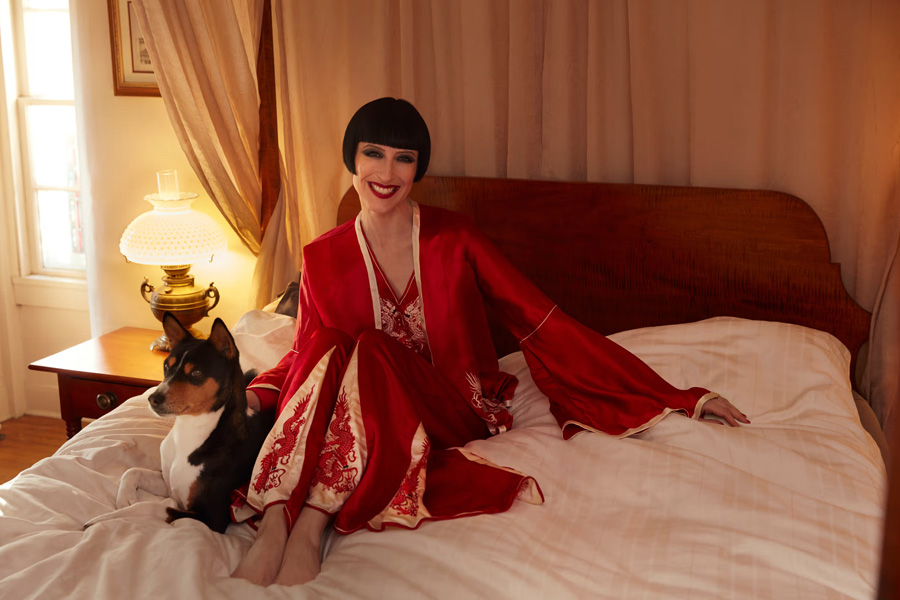
Another remarkable feature of her career is her visual and cultural presence. She has become known not only for Egyptology, but also for a carefully cultivated vintage style and a strong public persona. That can sound superficial if described badly, but in her case it seems tied to a larger mission. She makes Egyptology visible. She turns it into something that can be seen, shared, and remembered.
Her documentary work, lecture appearances, blog posts, and social media activity all build this same effect. She appears to understand that scholarship today often needs more than correctness. It needs form, rhythm, and reach. In that sense, she is a bridge figure. She links academic Egyptology to a wider audience that may come for fashion, storytelling, or visual appeal and stay for the history.
She also curated an exhibition on ancient Egypt at Yale’s Peabody Museum. That role matters because curation is translation. It means shaping an experience, not just presenting objects. It means turning knowledge into atmosphere. In her hands, ancient artifacts seem less like museum furniture and more like fragments of a still speaking world.
Family life and personal relationships
Dr. Darnell’s marriage to Egyptologist and scholar John Coleman Darnell is her most well-documented family tie. Their collaboration is intellectual and personal. This provides symmetry to their story. Not just spouses. Collaboration in a shared scholarly universe.
Her husband and coauthor is John Coleman Darnell. They have collaborated on publications, talks, and public discussions. Their relationship resembles mirrors and lanterns. They complement each other’s strengths. Such a union is rare in academia. It seems crucial to her.
The public information cites Selqet and Montu, two basenji dogs, and Durham, Connecticut. The profile is warmer with those details. They evoke a house of learning, friendship, and character. The minor household nuances that humanize a resume-only character are important.
No solid public information regarding other family members was found, and I won’t manufacture any. The documented family circle is small but significant. A partner, a shared professional world, and an intelligent, stylish home. Enough to draw a portrait.
Legacy in progress
Dr Colleen Darnell’s story is not finished. It is still moving. Her books continue to circulate, her lectures continue to draw attention, and her public presence continues to grow. She stands at an interesting intersection of ancient history and modern presentation. She has made a life out of understanding civilizations that vanished thousands of years ago while remaining unmistakably alive in the present.
What I notice most is balance. She balances rigor with charisma, scholarship with accessibility, and the formal world of academia with a more theatrical public voice. That balance gives her work texture. It gives her career momentum. It also gives her audience a reason to keep watching, reading, and listening.
FAQ
Who is Dr Colleen Darnell?
Dr Colleen Darnell is an Egyptologist, author, educator, curator, and public scholar known for her work on ancient Egyptian texts, history, archaeology, and cultural interpretation.
What is Dr Colleen Darnell known for?
She is known for her Yale training, her teaching career, her archaeological fieldwork, her books on ancient Egypt, and her public communication work through lectures, documentaries, and social media.
Who is her husband?
Her husband is John Coleman Darnell, who is also a scholar of Egyptology and a coauthor on some of her work.
What family members are publicly confirmed?
The publicly confirmed family member in the available material is her husband, John Coleman Darnell. The material also mentions their two basenji dogs, Selqet and Montu, as part of their home life.
What books has she worked on?
Her notable books include Tutankhamun’s Armies, Imagining the Past: Historical Fiction in New Kingdom Egypt, and Egypt’s Golden Couple: When Akhenaten and Nefertiti Were Gods on Earth.
What is the Mo’alla Survey Project?
The Mo’alla Survey Project is an archaeological field project she directed that helped reveal important features of the ancient landscape and burial environment in Egypt.
Where has she taught?
She taught at Yale University for many years and later taught art history at Naugatuck Valley Community College.
What makes her public image distinctive?
Her public image combines serious Egyptology with a strong visual identity, especially vintage fashion, making her stand out as both a scholar and a communicator.