A Worcester Childhood Shaped by Family and Football
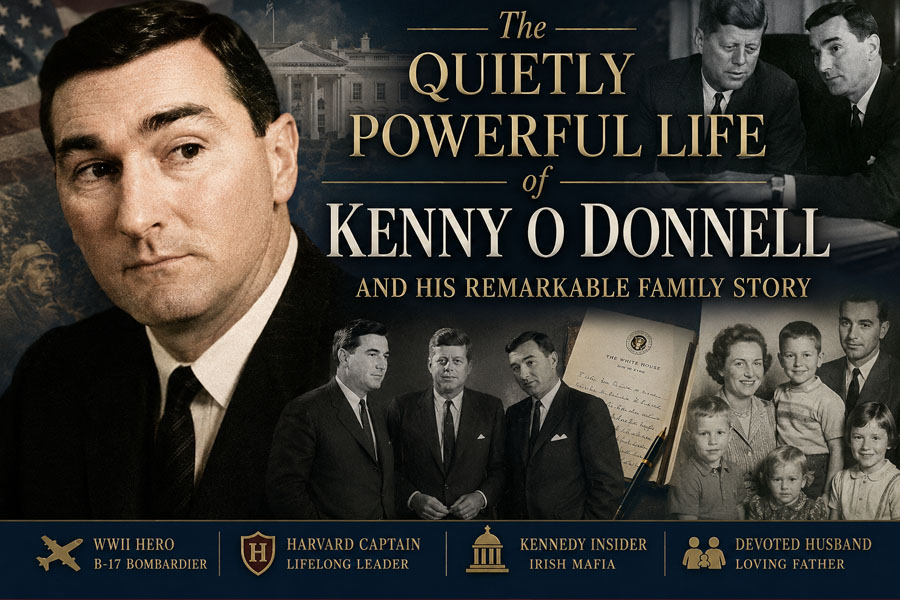
I find Kenny O Donnell’s story fascinating because his life unfolded close to the center of American power while he himself rarely seemed interested in becoming the center of attention. Kenneth Patrick O’Donnell was born on March 4, 1924, in Worcester, Massachusetts, into a Roman Catholic family with strong Irish roots and a deep connection to sports, education, and public life.
His father, Cleo Albert O’Donnell, was a celebrated football coach and athletics director whose career included influential positions at schools such as Purdue, St. Anselm, and the College of the Holy Cross. At Holy Cross, Cleo became an important figure in collegiate athletics. The family atmosphere was competitive, disciplined, and intellectually curious. Politics and government were familiar subjects, but football was almost a language of its own.
Kenny grew up alongside siblings including his older brother Cleo Jr., who became a Harvard football captain. His childhood gave him an unusual combination of influences: Catholic family traditions, Massachusetts political culture, athletic competition, and a strong expectation of achievement.
Those qualities would later become visible in his political career. O’Donnell was not a flamboyant personality. He was described as private, dryly humorous, self-effacing, and intensely loyal. Behind that quiet exterior was someone who understood competition and understood people.
From B 17 Bombardier to Harvard Quarterback
World War II changed the direction of O’Donnell’s young life. After graduating from Worcester Classical High School, he enlisted in the U.S. Army Air Forces in 1942. He became a B 17 bombardier with the Eighth Air Force and flew approximately 30 missions over Europe.
His wartime experience was anything but routine. O’Donnell was shot down over Belgium and managed to escape captivity. His service earned him the Distinguished Flying Cross and Air Medal.
When he returned to civilian life, Harvard University became the next important chapter. He studied government and graduated in 1949 with a bachelor’s degree. At Harvard, football again became an important part of his identity. He played quarterback and eventually became captain of the team.
Harvard also gave him one of the most consequential friendships of his life. He became roommates and football teammates with Robert F. Kennedy. Their relationship developed into a deep personal bond that extended far beyond college.
O’Donnell had already become involved in John F. Kennedy’s political world by 1946, when Robert Kennedy recruited him for JFK’s first congressional campaign. What began as campaign work gradually became a lifelong association with the Kennedy family.
He briefly attended Boston College Law School from 1950 to 1951 but did not complete the program. Instead, he worked in sales and public relations while continuing to build his political experience.
The Making of a Kennedy Insider
By the 1950s, O’Donnell was no longer simply a friend helping with campaigns. He had become one of the people who understood how the Kennedy political organization actually worked.
He helped organize John F. Kennedy’s successful 1952 Senate campaign and played an important role in Kennedy’s 1958 reelection campaign. From 1957 to 1959, he served as assistant counsel to the Senate Select Committee investigating labor management racketeering, where Robert Kennedy was a central figure.
The 1960 presidential campaign transformed his responsibilities. O’Donnell became a key organizer and scheduling strategist for Kennedy’s campaign. His talents were particularly suited to the complicated machinery behind a presidential candidate. He could organize people, manage competing demands, anticipate problems, and protect the candidate’s time.
When Kennedy entered the White House in January 1961, O’Donnell followed him.
He became Special Assistant and Appointments Secretary, a position that gave him enormous practical influence. He controlled access to the president, managed schedules, arranged trips, handled political problems, and helped determine who could get through the White House door.
His influence earned him the nickname “the Cobra.” The image was fitting. O’Donnell could be courteous, but he could also be formidable when he believed the president’s interests were being threatened.
The Irish Mafia and the Inner Circle
The Kennedy White House contained intellectuals, diplomats, economists, political strategists, family members, and longtime Massachusetts allies. Among the most distinctive groupings was the informal circle that became known as the “Irish Mafia.”
The label was not intended to describe organized crime. It referred to a close-knit group of Irish American Catholic political associates from Massachusetts who had worked with Kennedy for years.
O’Donnell was generally considered one of its central members, alongside Larry O’Brien and Dave Powers.
Their abilities were complementary. O’Donnell was the gatekeeper and political troubleshooter. O’Brien was a master of organization, elections, and congressional relations. Powers was the intimate friend who provided Kennedy with companionship, humor, and emotional familiarity.
Robert Kennedy occupied a somewhat different position because he was JFK’s brother and attorney general, but his relationship with O’Donnell connected the personal and political worlds surrounding the president.
I see the group less as a formal organization than as a political family. They shared history, loyalty, Massachusetts roots, Catholic traditions, and years of hard campaigning. They knew Kennedy before the presidency, which gave them a perspective that many newer Washington advisers did not possess.
Their approach was practical rather than academic. They knew precincts, voters, schedules, personalities, grudges, alliances, and political pressure points. While the intellectual advisers might debate a problem in a conference room, O’Donnell and his allies were often thinking about how the decision would work in the real political world.
That made O’Donnell particularly valuable to Kennedy. He was close enough to offer blunt advice and disciplined enough to keep difficult opinions private.
Dallas and the Shattering of a Political Family
November 22, 1963, divided O’Donnell’s life.
He was in Dallas when Kennedy was killed. The event crushed him personally and professionally. The political universe he helped build for nearly two decades altered.
O’Donnell served under Lyndon B. Johnson. He worked for the Democratic National Committee after being a special assistant. He supported Johnson’s 1964 reelection.
The Kennedy era left an emotional mark that could not be obliterated by a new government.
When Robert F. Kennedy was slain during his presidential campaign in 1968, the sorrow deepened. Former RFK campaign adviser O’Donnell was again confronted with the horrific destruction of a dear friend.
His family later described the Kennedy assassinations’ psychological effects. Kenny and Helen, his first wife, struggled with alcoholism. The family struggled as the losses piled up.
Additionally, O’Donnell’s brother Warren was shot when intervening in a heist and died from complications.
Helen Sullivan O Donnell and a Family Under Pressure
Kenny O’Donnell married Helen Sullivan in 1947 while he was at Harvard. Helen worked at times as a clerk in the Massachusetts Supreme Court, and the couple eventually had five children.
Their children were Kenneth Jr., twins Kathleen and Kevin, Mark, and Helen.
The family lived near extraordinary political history, but the children themselves generally remained outside the spotlight. That privacy became increasingly important as the family experienced grief and personal difficulties.
Helen Sullivan O’Donnell struggled with alcoholism and died in January 1977 at approximately 50 years old. Her death came only months before Kenny’s own death.
The family story is therefore not simply one of political privilege. It is also a story of grief, addiction, loyalty, and the private consequences of living through extraordinary public events.
The Children Who Preserved the Family Story
Kenny’s children largely maintained private lives, although several became part of the historical record through family references.
Kenneth P. O’Donnell Jr. was mentioned in contemporary accounts and later became associated with the preservation and donation of his father’s papers. Kathleen O’Donnell, later known as Kathleen Schlichenmaier, was living in Texas when her father died. Kevin was one of the twins, while Mark was another of Kenny’s sons.
His younger daughter, Helen O’Donnell, became the most visible custodian of her father’s historical memory.
Helen developed a career as an author, historian, journalist, researcher, and producer. Her work drew heavily on family materials, including her father’s notes, diaries, tapes, and recollections.
Her 1998 book A Common Good examined the friendship between Robert F. Kennedy and Kenny O’Donnell. She also worked on Launching LBJ, exploring the transition from the Kennedy administration to the Johnson presidency through her father’s experiences.
In later interviews and public appearances, Helen discussed the private effects of the Kennedy assassinations and the alcoholism that affected her parents. Through her work, Kenny’s personal voice survived in a way that official political histories often cannot provide.
His notes reveal a man who was constantly observing, recording, and analyzing. He understood that history was being made around him, even when he was not the person standing behind the microphone.
A Second Marriage and a Final Year
After Helen Sullivan’s death in January 1977, Kenny’s personal life changed again. Later that year, he married Asta Hanna Helga Steinfatt, a native of Germany.
The marriage lasted only a short time.
O’Donnell was hospitalized on August 11, 1977, with serious gastrointestinal problems associated with his long struggle with alcoholism. He died in Boston on September 9, 1977, at the age of 53.
His funeral was attended by members of the Kennedy family, including Jacqueline Kennedy Onassis. He was buried at Holyhood Cemetery.
His death came at a surprisingly young age for a man who had already lived several political lifetimes. He had been a decorated wartime airman, Harvard football captain, political operative, presidential adviser, campaign strategist, candidate for governor, author, and trusted friend to two assassinated Kennedy brothers.
From Political Operator to Historical Figure
After 1965, O’Donnell founded his own management consulting firm and remained involved in Democratic politics. He made unsuccessful bids for the Massachusetts Democratic gubernatorial nomination in 1966 and 1970.
He also worked with Hubert Humphrey and remained connected to Kennedy political circles. In 1972, he and Dave Powers co-authored Johnny, We Hardly Knew Ye, a collection of memories about John F. Kennedy.
O’Donnell’s own financial life was comparatively understated. There is no strong public record of enormous wealth or a spectacular estate. His income came from government service, earlier sales and public relations work, political activities, and his consulting business. His influence was far greater than his publicly documented fortune.
That contrast is one of the most interesting features of his life. O’Donnell could stand near the president of the United States and wield considerable influence without accumulating the kind of celebrity or wealth associated with powerful political figures.
The Enduring Family Legacy
The papers and recollections his children kept perpetuate Kenny O’Donnell’s family tale.
His writings helped explain the Kennedy administration, while Helen’s books revealed the human relationships behind politics.
O’Donnell has also returned to popular culture through films and TV. He appeared in Thirteen Days, Jackie, LBJ, and Killing Kennedy. Some portrayals emphasise the hard-edged political operator, but the family record shows another side.
He suffered great losses as a husband, father, brother, veteran, and friend.
Public Kenny O’Donnell protected the president’s schedule and managed White House access. The private Kenny was sculpted by wartime peril, family expectations, friendship, bereavement, and almost tenacious dedication to loved ones.
FAQ
Who was Kenny O’Donnell?
Kenny O’Donnell was an American political consultant and longtime adviser to John F. Kennedy. He served as Kennedy’s Special Assistant and Appointments Secretary from 1961 until the president’s assassination in 1963.
When was Kenny O’Donnell born?
Kenny O’Donnell was born on March 4, 1924, in Worcester, Massachusetts.
What did Kenny O’Donnell do during World War II?
He served in the U.S. Army Air Forces as a B 17 bombardier with the Eighth Air Force. He flew approximately 30 missions over Europe, was shot down over Belgium, escaped captivity, and received the Distinguished Flying Cross and Air Medal.
How was Kenny O’Donnell connected to Robert F. Kennedy?
O’Donnell and Robert F. Kennedy were roommates and football teammates at Harvard. Their friendship developed into a close political and personal relationship that lasted for decades.
Who was Kenny O’Donnell’s first wife?
His first wife was Helen Sullivan O’Donnell, whom he married in 1947. They had five children together. Helen died in January 1977.
Who were Kenny O’Donnell’s children?
His five children were Kenneth Jr., twins Kathleen and Kevin, Mark, and Helen O’Donnell. His daughter Helen later became an author, historian, journalist, and researcher who wrote extensively about her father’s relationship with the Kennedy family.
Who was Kenny O’Donnell’s second wife?
His second wife was Asta Hanna Helga Steinfatt, a German native whom he married in 1977, shortly before his death.
What was the Irish Mafia?
The “Irish Mafia” was an informal nickname for the close group of Irish American political associates surrounding John F. Kennedy. Kenny O’Donnell, Larry O’Brien, and Dave Powers were commonly identified as its central members.
Why was Kenny O’Donnell called the Cobra?
The nickname reflected his formidable control over access to President Kennedy. As Appointments Secretary, O’Donnell helped determine who met the president, managed his schedule, and handled sensitive political demands.
When did Kenny O’Donnell die?
Kenny O’Donnell died on September 9, 1977, in Boston, Massachusetts. He was 53 years old.
Where is Kenny O’Donnell buried?
He was buried at Holyhood Cemetery in Massachusetts, following a funeral attended by members of the Kennedy family and other people connected to his long political career.